
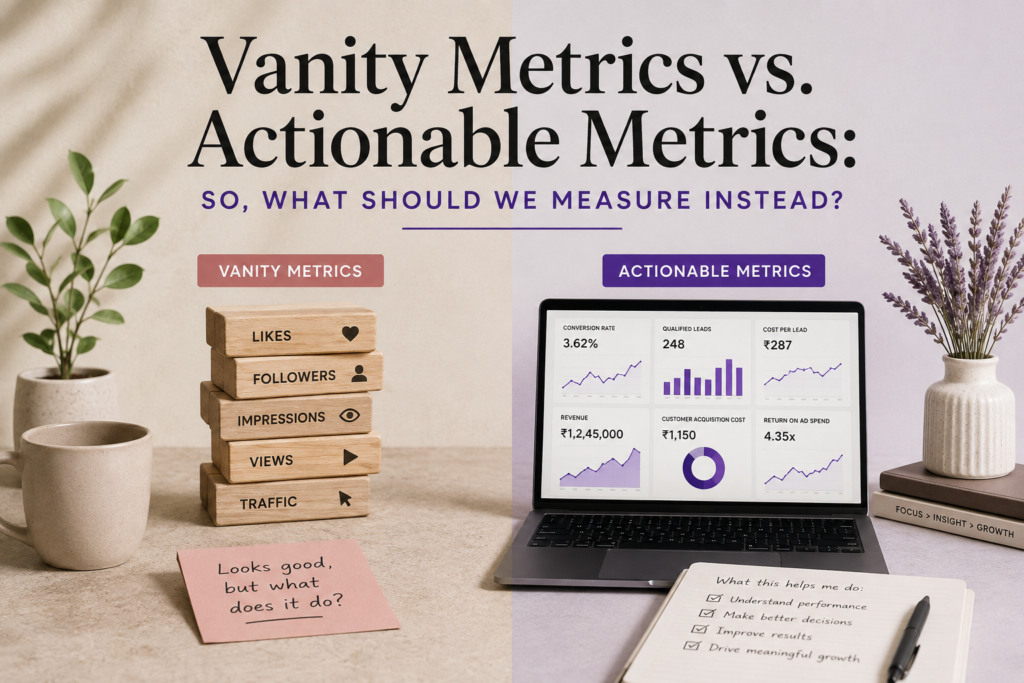
Actionable metrics are often more useful than numbers that simply look impressive. We talk about numbers a lot in Digital Marketing.
How many people saw the post.
How many clicked.
How many followed.
How many visited the website.
And somewhere along the way, it became easy to assume that a bigger number automatically means better marketing.
But it doesn’t.
In my earlier article, The Problem With Chasing Vanity Metrics, I explored why impressive numbers can sometimes tell us very little about whether our marketing is actually working.
Which brings us to the more important question:
If vanity metrics aren’t enough, what should we measure instead?
This is where actionable metrics come in.
The difference isn’t simply about which numbers are “good” and which ones are “bad.” It’s about whether a number gives you something you can understand, learn from and act upon.
Because at the end of the day, marketing isn’t about collecting numbers. It’s about knowing what those numbers mean.
What are Vanity Metrics?
Vanity metrics are numbers that look impressive but don’t necessarily tell you what you need to know. Think about followers, likes, impressions, website traffic or video views. Seeing those numbers increase can certainly feel good. And sometimes, they can be useful indicators of attention or awareness. But the problem starts when we use them as the only evidence that something is working.
Imagine a campaign gets 100,000 impressions. That’s a big number. But what if those impressions didn’t lead to clicks, enquiries, sign-ups or sales? The number tells you that people saw something. It doesn’t necessarily tell you what happened because they saw it.
And that’s the distinction we need to pay attention to. Vanity metrics aren’t inherently useless. They’re simply not always enough on their own.
What Makes a Metric Actionable?
An actionable metric gives you information that can help you make a decision. It doesn’t just tell you what happened. It gives you a reason to ask why it happened and what you might do next. For example, website traffic can tell you how many people visited your website. But conversion rate can help you understand how effectively those visitors are taking the action you want them to take.
Similarly, follower count can tell you how large your audience is. But qualified leads can tell you whether your marketing is actually attracting people who may become customers. The difference isn’t necessarily the number itself. It’s the question behind the number.
An actionable metric should help you answer questions such as:
- Are we reaching the right people?
- Are people taking the action we want?
- Which campaign is performing better?
- Where are potential customers dropping off?
- Is our marketing contributing to the business goal?
When a metric helps you answer questions like these, it becomes much more useful.
Vanity Metrics vs. Actionable Metrics
The easiest way to understand the difference is to look at them side by side.
|
Vanity Metrics
|
Actionable Metrics
|
|---|---|
But there’s something important to remember here.
The left column isn’t automatically bad. And the right column isn’t automatically good.
A follower count can be useful if your objective is measuring audience growth. Impressions can be useful when you’re evaluating brand awareness. Website traffic can be useful when you’re trying to understand whether your content is attracting an audience. The problem comes when we take a metric out of context and use it to make a conclusion it was never designed to support. A number becomes meaningful when you know what question you’re asking it to answer.
Because Numbers Need Context
Consider this:
Two websites each receive 10,000 visitors in a month. At first glance, they appear to be performing equally well. But Website A generates 100 qualified leads and website B generates 10.
Suddenly, the 10,000 visitors don’t tell us very much. The same thing can happen with social media. Two accounts may have 20,000 followers each. One might generate meaningful conversations, enquiries and sales. The other might have an audience that rarely interacts with the brand or takes any further action. The follower count is identical. The outcome isn’t.
This is why context matters.
A metric doesn’t exist in isolation. It exists in relation to a goal. And once you understand that, the question changes from:
“Is this number big?” to “Does this number tell me something useful?”
That’s a much better question to ask.
So, What Should We Measure Instead?
There isn’t a universal list of metrics that every marketer should track. The right metrics depend on what you’re trying to achieve. If your goal is awareness, you need to understand visibility. If your goal is leads, you need to understand whether the right people are taking action. If your goal is sales, you need to understand whether marketing is contributing to revenue. The goal should determine the metric.
If the Goal Is Awareness
For an awareness campaign, metrics such as:
- Reach
- Impressions
- Branded searches
- Audience growth
- Relevant engagement
can be useful. In this situation, visibility is part of the objective. So measuring visibility makes sense. The problem isn’t measuring impressions. The problem is assuming that impressions alone prove that the campaign was successful.
If the Goal Is Engagement
Engagement can tell you whether people are responding to your content. Depending on the platform and objective, you might look at:
- Saves
- Shares
- Comments
- Engagement rate
- Time spent with content
- Click-through rate
Again, context matters. A thousand likes might look impressive. But if your actual goal is getting people to visit your website, click-through rate may tell you far more.
If the Goal Is Lead Generation
Now the numbers become much more closely connected to business outcomes.
You might measure:
- Qualified leads
- Conversion rate
- Cost per lead
- Landing-page conversion rate
- Lead-to-customer rate
Instead of simply asking how many people visited, you’re asking: Did the right people take the next step? That’s a much more useful question for a lead-generation campaign.
If the Goal Is Sales
When sales are the objective, you might look at:
- Revenue
- Conversion rate
- Customer acquisition cost
- Average order value
- Return on marketing investment
These metrics help connect marketing activity with the outcome that ultimately matters to the business. Because getting attention is valuable. But turning attention into action is what creates business value.
If the Goal Is Organic Growth
SEO is another area where it’s easy to become obsessed with numbers.
Rankings and organic traffic are important signals.
But ranking for a keyword that doesn’t attract the right audience isn’t necessarily a victory.
For organic growth, you might also look at:
- Relevant organic traffic
- Organic conversions
- Qualified leads from search
- Search visibility
- Revenue generated through organic search
The goal isn’t simply to get more people from search engines. It’s to get the right people to the right content at the right point in their journey.
The Question Behind Every Metric
Before adding another number to your marketing dashboard, ask yourself:
What am I trying to understand?
If you’re trying to understand whether your content is reaching people, reach may be useful. If you’re trying to understand whether those people are becoming customers, reach isn’t enough. If you’re trying to understand whether your landing page is working, conversion rate may be more useful. The metric should follow the question. And then comes another question that is even more important:
What would I do differently if this number changed?
If your answer is nothing, perhaps the metric doesn’t deserve as much attention as you’re giving it. This doesn’t mean every metric needs to directly generate revenue. Some metrics are valuable because they help you understand behaviour. Some help you identify problems. Some help you decide where to invest more time or money. The point is not to find one magical number.
It’s to understand which numbers help you make better decisions.
More Data Doesn't Mean Better Marketing
Digital Marketing gives us access to an incredible amount of data. We can track clicks, views, impressions, sessions, engagement, conversions, rankings and countless other things. And that sounds like an advantage.
But more data doesn’t automatically lead to better decisions.
Sometimes, it does the opposite. When you’re looking at twenty different numbers, it’s easy to lose sight of the one question you’re actually trying to answer. You don’t need to measure everything simply because you can. You need to measure what helps you understand whether you’re moving towards your goal.
More data is not the same as more clarity.
Stop Measuring Everything. Start Measuring What Matters.
Perhaps the biggest shift in mindset is this:
Don’t start with the metric.
Start with the goal.
Then ask:
What do I want to understand?
Then:
Which metric can help me answer that question?
And finally:
What will I do with what I learn?
A simple framework could look like this:
Goal → Question → Metric → Action
For example:
Goal: Generate qualified leads.
Question: Are we attracting people who are genuinely interested in what we offer?
Metric: Qualified lead rate and conversion rate.
Action: Improve targeting, messaging or the landing-page experience based on what the data shows.
That’s measurement with a purpose. And that’s very different from opening a dashboard simply to see whether a number went up.
Final Thoughts
Vanity metrics aren’t necessarily meaningless. They can tell us something about attention, visibility or audience growth. But they’re rarely the whole story.
Actionable metrics take the conversation one step further. They help us understand what happened, why it matters and what we might do next. And perhaps that’s the real difference.
It’s not about choosing impressive numbers over unimpressive ones. It’s about choosing numbers that help you make better decisions. Because good Digital Marketing isn’t about having the biggest numbers on the dashboard. It’s about knowing which numbers deserve your attention.
If you’re still wondering why some impressive numbers can tell us surprisingly little about marketing performance, you can start with The Problem With Chasing Vanity Metrics. Because before we decide what to measure, it helps to understand why chasing the wrong numbers can be a problem in the first place.